
SEO Services
Onsite SEO Audit Service: What Problems Should Be Fixed Before Link Building?
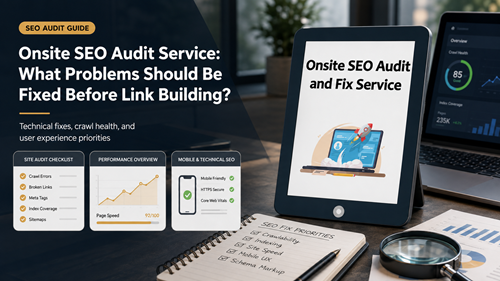
Sep
An Onsite SEO Audit Service should identify problems that prevent a website from converting new authority into stronger search performance. Building more links to pages that are blocked, duplicated, poorly structured, slow, or targeting the wrong intent can waste budget and make diagnosis harder later.
The goal is not to produce the longest possible audit. It is to prioritize the technical and on-page issues that affect important pages, explain how they were validated, and provide an implementation sequence. Some findings are critical; others are minor hygiene items that should not delay growth work.
Why an Onsite SEO Audit Service Should Come Before Aggressive Link Building
Links can help search engines discover pages and can contribute authority, but they do not repair a broken information architecture. If internal links point to redirected URLs, canonical tags select the wrong version, or important pages are not indexable, external authority can be diluted or sent to the wrong destination.
An audit should begin with the pages that matter commercially. Crawl data becomes more useful when it is combined with analytics, Search Console, sitemap status, server responses, internal links, and the business’s priority services or products.
An Onsite SEO Audit Service should therefore produce a prioritized implementation backlog. Each finding needs affected URLs, evidence, severity, recommended action, and a validation step after the fix.
Technical Problems to Resolve Before Earning More Links
Repair Crawl and Response Errors
Important URLs should return the intended status code and be reachable through normal internal navigation. Broken links, redirect loops, soft 404s, and accidental blocks make crawling less efficient and create poor user paths.
Start crawl error remediation with high-value pages and links that users actually encounter, then expand the cleanup to sitemap and crawler-discovered errors.
Diagnose Indexation Before Changing Content at Scale
A page can be technically crawlable yet excluded because of noindex, canonical selection, duplication, low-value content, redirects, or other signals. Each exclusion type requires a different response.
An indexation problem diagnosis should compare intended indexability with actual search-engine behavior rather than assuming every URL in a crawl should appear in Google.
Resolve Canonical Conflicts
Canonical tags should identify the preferred version of duplicate or very similar content. Internal links, redirects, and sitemaps should reinforce that choice where possible.
Use Google’s canonicalization documentation when performing canonical tag cleanup so redirects, canonicals, and sitemap signals do not contradict one another.
Audit Priority Before Link Building
Not every onsite issue should block off-page work. Prioritize findings that directly affect indexability, target-page relevance, or user access.
| Finding | Priority | Why It Matters Before Links |
|---|---|---|
| Blocked or noindexed target page | Critical | External authority cannot support the intended indexed page |
| Wrong canonical target | Critical | Signals can consolidate to another URL |
| Redirect chains or broken links | High | Authority and users follow inefficient paths |
| Weak internal linking | High | Search engines receive poor hierarchy and context |
| Thin target-page content | High | Links cannot replace missing relevance |
| Minor metadata inconsistency | Medium | Fix important templates, but not every variation blocks growth |
Turn the Audit into an Implementation Sequence
Review Internal Linking as Site Architecture
Internal links distribute authority and communicate hierarchy. Important service, collection, or product pages should not depend on one buried link or orphaned sitemap entry.
An internal linking audit process should identify orphan pages, redirecting links, weak anchor context, excessive depth, and pages receiving too little internal attention.
Fix Metadata Where It Changes Search Understanding
Titles and descriptions should accurately distinguish important pages. Duplicate metadata is more urgent when it reflects duplicate intent or templating problems across commercial URLs.
Use a metadata quality review to prioritize pages with impressions, conversions, strategic importance, or obvious duplication instead of rewriting every low-value archive automatically.
Improve Performance Without Treating Scores as the Goal
Page speed work should focus on real user experience, especially on key mobile templates. Large images, render-blocking scripts, layout shifts, and heavy third-party code can affect both usability and search performance.
Google defines LCP, INP, and CLS in its Core Web Vitals guidance. Use those metrics when planning Core Web Vitals fixes and validate changes with field data when available.
A practical technical website audit checklist keeps implementation focused on the issues that could prevent priority pages from benefiting from stronger authority.
Pre-Link-Building Technical Checklist
- Confirm target pages are indexable
- Validate canonical targets
- Fix broken internal links
- Reduce unnecessary redirect chains
- Check sitemap inclusion
- Review robots and noindex rules
- Strengthen internal links to targets
- Validate title and H1 intent
- Check mobile template usability
- Review Core Web Vitals
- Verify structured data where relevant
- Recrawl after implementation
After fixes are deployed, recrawl the affected templates and inspect a sample of priority URLs. Link building should begin only after the team confirms that the intended pages are accessible, indexable, internally supported, and relevant to the queries being targeted.
Validate the Audit by Closed Issues, Not Finding Count
A 200-item audit is not useful if the business implements none of it. Track critical issues closed, affected URLs reduced, important pages indexed, internal link improvements, Core Web Vitals trends, and changes in search visibility after implementation.
An Onsite SEO Audit Service should also document what was intentionally left unchanged. That prevents future teams from repeatedly flagging acceptable platform behavior or low-impact issues as urgent.
Make the Website Ready to Benefit from New Authority
An Onsite SEO Audit Service should remove the technical and relevance bottlenecks that would weaken a link-building campaign. Fix indexability, canonicals, crawl paths, internal links, important metadata, and major performance problems first.
Then verify the fixes. External authority is more valuable when it points to pages that search engines can clearly crawl, index, understand, and connect to the rest of the site.
Frequently Asked Questions
Should all technical SEO issues be fixed before building any links?
No. Critical indexation, canonical, crawl, and target-page relevance problems should be addressed first, while lower-impact hygiene issues can be scheduled alongside growth work.
How often should a website receive a technical SEO audit?
Frequency depends on site size and change rate. Large ecommerce or frequently deployed sites need more regular monitoring than small stable service websites.
Can backlinks fix a page that is not indexed?
Backlinks may help discovery, but they do not override noindex directives, serious canonical conflicts, or weak content. Fix the underlying issue first.
What is the most important part of an audit report?
Prioritization. Each finding should show the affected pages, evidence, severity, recommended fix, owner, and validation method.
Should Core Web Vitals block link building?
Only when performance problems materially affect important templates or user experience. Treat them according to impact rather than as an isolated score-chasing exercise.
