
Local SEO Services
Law Firm Digital Marketing: How SEO Supports Qualified Local Leads
Sep
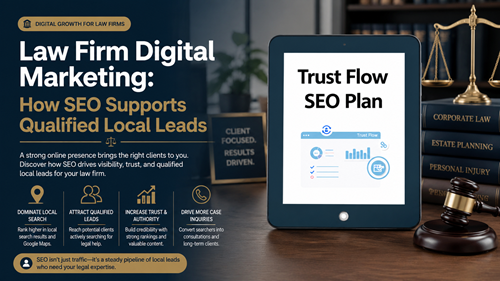
Law Firm Digital Marketing should connect local search visibility with the practice areas, locations, and client situations the firm can actually serve. More traffic is not automatically better if visitors are outside the jurisdiction, seeking a different legal service, or unlikely to become qualified consultations.
SEO supports lead quality by giving each important practice area a clear landing page, strengthening the firm’s local presence, answering high-intent questions, and making calls to action easy to use on mobile. The strategy should also respect professional advertising rules and avoid guarantees or claims the firm cannot substantiate.
How Law Firm Digital Marketing Turns Search Visibility into Better Inquiries
Legal searches often have strong intent but wide variation. Someone researching a general legal question is different from a person looking for immediate representation in a specific city. Keyword mapping should separate informational topics, practice-area intent, and location intent so each search has an appropriate destination.
The website should make trust easy to evaluate. Attorney biographies, office details, practice focus, process explanations, contact options, and transparent disclaimers can help prospective clients understand whether the firm is relevant before contacting it.
Law Firm Digital Marketing works best when SEO and intake data are connected. If a page ranks well but generates inquiries the firm cannot take, the keyword target or page positioning may need to change.
SEO Elements That Support Qualified Legal Leads
Build Practice-Area Pages Around Real Client Intent
A practice-area page should explain who the service is for, common situations, the firm’s process, location or jurisdiction constraints, and what a prospective client can do next. Thin pages that repeat the same city keywords do little to establish relevance.
A focused law firm landing page SEO plan should map one primary intent to each page and use supporting questions without creating dozens of near-duplicate location pages.
Treat Local Search as an Accuracy System
Office addresses, service areas, phone numbers, hours, website links, categories, and reviews should be consistent across the website and Google Business Profile. Firms with multiple offices need especially careful location governance.
A strong legal practice local search strategy should coordinate location pages, profile data, citations, reviews, and local relevance rather than relying on one map optimization tactic.
Map Keywords to Practice Economics
Search volume alone can attract the wrong cases. Prioritize terms by practice fit, geography, urgency, competitiveness, and the value of a qualified consultation to the firm.
Use legal services keyword targeting to separate informational questions from commercial searches and to avoid multiple pages competing for the same practice-area phrase.
Legal SEO Funnel from Search to Qualified Consultation
Each stage needs a different signal. Ranking is only the start of the acquisition path.
| Stage | SEO or Website Job | Quality Signal |
|---|---|---|
| Discovery | Appear for relevant practice and local searches | Query matches service and jurisdiction |
| Evaluation | Explain credentials, process, and fit | Visitor reaches attorney and service information |
| Contact | Provide clear mobile call and form options | Inquiry includes useful case details |
| Qualification | Route leads by practice and location | Consultation meets intake criteria |
| Conversion | Follow up consistently | Qualified consultation becomes a client |
| Learning | Feed intake outcomes back to marketing | Pages and keywords improve over time |
Build an SEO Program Around Local Trust and Intake
Strengthen Google Visibility Without Over-Optimizing
Google Business Profile can support local discovery when the firm uses accurate business information, appropriate categories, current photos, and a consistent review-response process.
For attorney Google visibility, keep profile claims factual and coordinate them with office location pages and the firm’s real client intake area.
Create Content That Helps People Self-Qualify
Useful legal content can explain process, terminology, deadlines in general terms, common questions, and what information a consultation may require. It should avoid individualized legal advice when context is missing.
An attorney lead generation strategy should use content to clarify service fit before the contact form, which can reduce irrelevant inquiries and improve intake efficiency.
Connect Search Activity to Client Acquisition
Analytics should distinguish calls, forms, chats, and appointment requests, but the firm also needs intake feedback. A lead that cannot be served should not be valued the same as a qualified consultation.
Measure client acquisition for law offices through consultation quality, signed matters, acquisition cost, and practice-area profitability where ethical and privacy requirements allow.
Law Firm SEO and Intake Checklist
- Map core practice areas to unique pages
- Verify office and profile information
- Review mobile call and form paths
- Add clear attorney biography links
- Use accurate service and jurisdiction language
- Create helpful FAQ content
- Track qualified calls and forms
- Review intake reasons for rejected leads
- Audit title and local intent overlap
- Check professional advertising requirements
Legal advertising requirements vary by jurisdiction and practice. The marketing team should coordinate claims, testimonials, disclaimers, and lead-generation practices with the firm’s professional-responsibility obligations.
Measure Qualified Consultations, Not Just Traffic
Organic traffic and rankings indicate visibility, but firms should also track calls by practice area, form quality, consultation bookings, lead acceptance rate, signed clients, and acquisition cost when those metrics can be handled securely.
Law Firm Digital Marketing improves when intake staff categorize leads consistently. That feedback shows whether the SEO strategy is attracting the right matters or simply increasing the number of contacts.
Use SEO to Improve Fit Before the First Consultation
Law Firm Digital Marketing should make the firm easier to find, easier to evaluate, and easier to contact for the right services and locations. Local profiles, practice-area pages, technical quality, useful content, and clear intake paths work together.
The best SEO program is not the one with the largest traffic chart. It is the one that contributes to a steady flow of appropriate, qualified inquiries while maintaining accurate and responsible marketing.
Frequently Asked Questions
Should every practice area have its own SEO page?
Major services with distinct search intent usually deserve dedicated pages. Closely related topics can often be covered together to avoid thin or competing pages.
Do law firms need Google Business Profile optimization?
For eligible local practices, an accurate and well-maintained profile can support discovery in Search and Maps, especially when office information is consistent.
Are blog posts useful for law firm SEO?
Yes when they answer real prospective-client questions and connect naturally to relevant practice-area pages. Blogs should not replace strong commercial service pages.
What is a qualified SEO lead for a law firm?
The definition should reflect practice area, jurisdiction, case type, urgency, and the firm’s intake criteria rather than simply counting every call or form.
How long does legal SEO take?
Timing varies by competition, site history, technical condition, content, local authority, and the queries targeted. Sustainable improvement usually requires ongoing work rather than a one-time change.
