
Local SEO Services
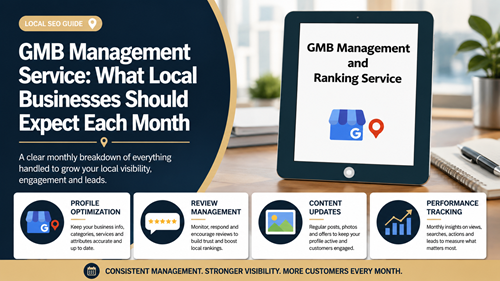
GMB Management Service: What Local Businesses Should Expect Each Month
Sep
A GMB Management Service should do more each month than publish a few posts and send a screenshot of profile views. Google Business Profile management is ongoing data quality, category control, service accuracy, review workflow, photo maintenance, posting, duplicate monitoring, and performance interpretation.
For a storefront or service-area business, the profile is one of the most visible local-search assets. Small errors in hours, categories, address rules, service areas, or duplicate listings can create customer confusion. A monthly management plan should therefore combine routine maintenance with issue detection and a documented response process.
What a GMB Management Service Should Manage Every Month
The first responsibility is accuracy. Name, address or service area, phone number, website, hours, appointment links, products, services, and attributes should match the real business and comply with Google guidelines. Seasonal hours and temporary changes need timely updates.
The second responsibility is activity that helps customers make decisions. Useful photos, service information, posts, offers, answers, and review responses can make the profile more complete. Activity should be relevant rather than published merely to create a deliverable count.
A GMB Management Service also needs a monitoring layer. Unexpected category changes, duplicate profiles, spam edits, ownership requests, review spikes, and verification problems can have more impact than the next scheduled post.
Monthly Activities That Separate Maintenance from Real Management
Keep Core Business Information Accurate
A manager should verify the profile against the business website and operating reality. Hours, phone numbers, service areas, appointment URLs, and business descriptions should not drift over time.
Google explains the core functions of Google Business Profile optimization through accurate information, customer interaction, and profile content. Use those basics as a recurring quality-control checklist.
Select Categories Carefully
Primary and additional categories influence how Google understands the business. Categories should describe what the business is, not every individual product or feature it offers.
Google states that GBP category selection should use the most specific category that describes the business. Category changes should be documented because they can affect visibility and sometimes trigger reverification.
Maintain Local Listing Consistency
Profile management should be coordinated with major citations and the business website. A changed phone number or address that is updated in only one place creates inconsistent entity information.
A local listing maintenance process should prioritize major authoritative directories and existing listings rather than creating a large number of low-value profiles simply to inflate citation counts.
Recommended Monthly Profile Management Cycle
The exact frequency varies by business, but each month should include maintenance, engagement, and diagnostic work.
| Workstream | Monthly Check | Evidence to Keep |
|---|---|---|
| Business data | Hours, phone, URL, service area, attributes | Change log and profile screenshot |
| Categories/services | Primary category and high-value services | Before/after category record |
| Content | Photos, posts, offers, updates | Published URLs or screenshots |
| Reputation | New reviews and response queue | Response completion and escalation notes |
| Listings | Key citation consistency | Priority citation audit |
| Performance | Searches, calls, clicks, directions | Trend summary with context |
How Ongoing Profile Work Should Support Local Visibility
Publish Useful Business Updates
Posts should communicate offers, seasonal information, events, new services, or practical customer information. Repetitive keyword-heavy posts create little value.
Consistent business profile posting should reflect real business activity and use calls to action that match what a customer can actually do from the profile.
Connect Profile Work with Local Search
Profile optimization works alongside the website, reviews, citations, local landing pages, and relevance of the business to the query. No single profile action guarantees map-pack rankings.
Use map pack visibility signals as a broader framework that includes profile relevance, website quality, review reputation, local links, and accurate business information.
Report Decisions, Not Just Numbers
A monthly report should explain what changed, why it changed, what customers did, and what needs attention next. Raw views without trend context can be misleading.
Useful local profile performance reporting should connect calls, website clicks, direction requests, review activity, and priority actions instead of presenting a dashboard without interpretation.
Monthly GMB Management Checklist
- Verify hours and contact details
- Review primary and additional categories
- Check services and attributes
- Publish relevant updates
- Add current photos
- Respond to reviews
- Inspect duplicate or spam issues
- Check priority citations
- Review calls and website clicks
- Document changes for next month
The manager should also maintain an escalation process for suspension, ownership, verification, duplicate, and malicious-edit problems. Routine content work should pause when a profile-level risk needs immediate attention.
Judge the Service by Local Actions and Data Quality
Profile impressions can rise or fall because of seasonality, query mix, competition, and Google interface changes. Combine visibility data with customer actions, calls, website visits, direction requests, review trends, and lead quality.
A GMB Management Service should leave the business with a more accurate, more complete, better documented local asset each month. If the only recurring activity is posting, the management scope is probably too narrow.
Expect Maintenance, Engagement, and Issue Monitoring
A GMB Management Service should protect business information, improve the profile’s usefulness, coordinate listings, manage engagement, and identify issues that could affect local visibility.
Ask for a monthly change log and a short action plan. That makes it easy to distinguish ongoing management from a service that simply publishes content on a fixed schedule.
Frequently Asked Questions
How often should a Google Business Profile be updated?
Core data should be corrected whenever it changes. Photos, posts, services, reviews, and performance can be reviewed on a regular monthly cadence with more frequent checks for active businesses.
Should a manager add many additional categories?
Only categories that genuinely describe the business should be used. Irrelevant categories can confuse customers and may reduce profile quality.
Do Google Business Profile posts directly improve rankings?
Posting can improve profile usefulness and engagement, but local ranking depends on a broader mix of relevance, distance, prominence, website signals, reviews, and other factors.
Should a service reply to every review?
A consistent response process is valuable, especially for questions, complaints, and detailed feedback. Responses should sound human and avoid revealing private customer information.
What should happen if the profile is suspended?
Routine publishing should stop while the manager verifies guideline compliance, documents business eligibility, and follows Google’s reinstatement or verification process.
